By Margaret Rae and Brian Nathanson
When the world sees you as a monster, sometimes the only way to find safety is to step into the light on the one night everyone else is wearing a mask.
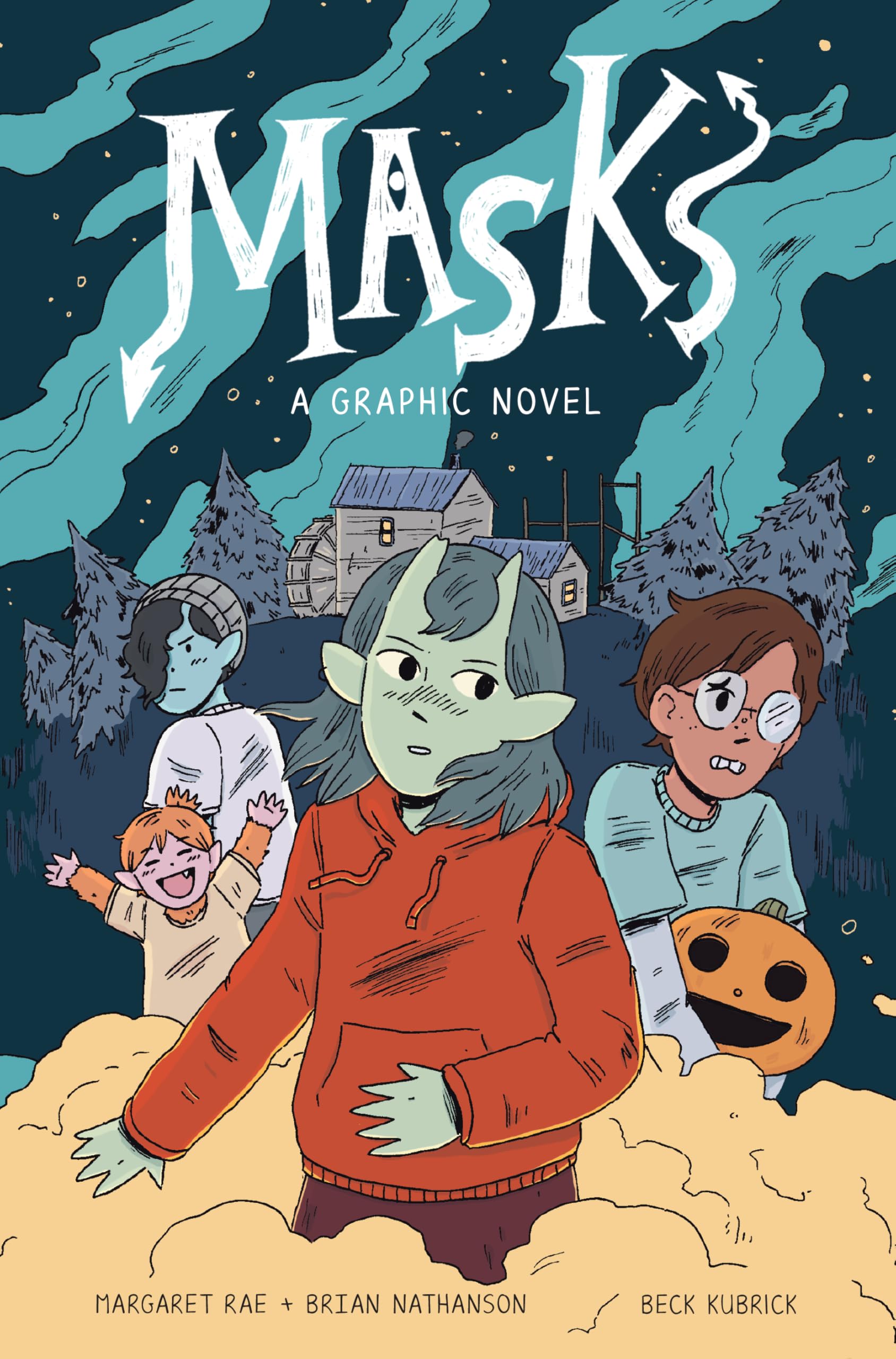
In Masks, a middle-grade graphic novel by Margaret Rae and Brian Nathanson, three monster children named Poe, Rice, and Shelley live in the shadows to avoid the “Knights of the Night” hunters. When their dilapidated hideout is scheduled for demolition, the trio decides to venture into the human world on Halloween—the one night their appearances won’t cause a panic—to find a rumored monster haven. For educators looking for bridging material for students aged 8 to 12, this book is a standout choice. The 240-page story relies heavily on Beck Kubrick’s expressive illustrations to convey the deep sense of loss and hope the characters feel. Because the narrative uses concise dialogue and straightforward sentence structures within speech bubbles, it serves as an excellent entry point for readers who might find a traditional prose novel intimidating. This accessibility is why critics at Kirkus Reviews and School Library Journal have praised it as a touching exploration of marginalized communities. It offers a sophisticated story without requiring a high Lexile level, making it a perfect fit for those building reading stamina.
Beyond its accessibility, this story is an effective tool for exploring UN Sustainable Development Goal 10: Reduced Inequalities. The monsters’ plight serves as a clear metaphor for real-world discrimination and systemic exclusion. By following Poe’s protective leadership and the group’s encounter with a sympathetic human boy named Vaughn, students can see the IB Learner Profile attribute of being open-minded in action. Teachers can use the visual cues in the artwork to prompt deep discussions about gentrification and how fear of the “other” often leads to injustice. For example, the “monster hunter” antagonists mightbe used to draw parallels to historical instances of persecution. Because the visual support allows English language learners to grasp the emotional weight of the plot, the whole class can participate in creating projects centered on social justice or anti-bullying. Ultimately, Masks shows young readers that finding where you belong often requires the courage to challenge the status quo, turning a spooky premise into a lesson on empathy and agency.