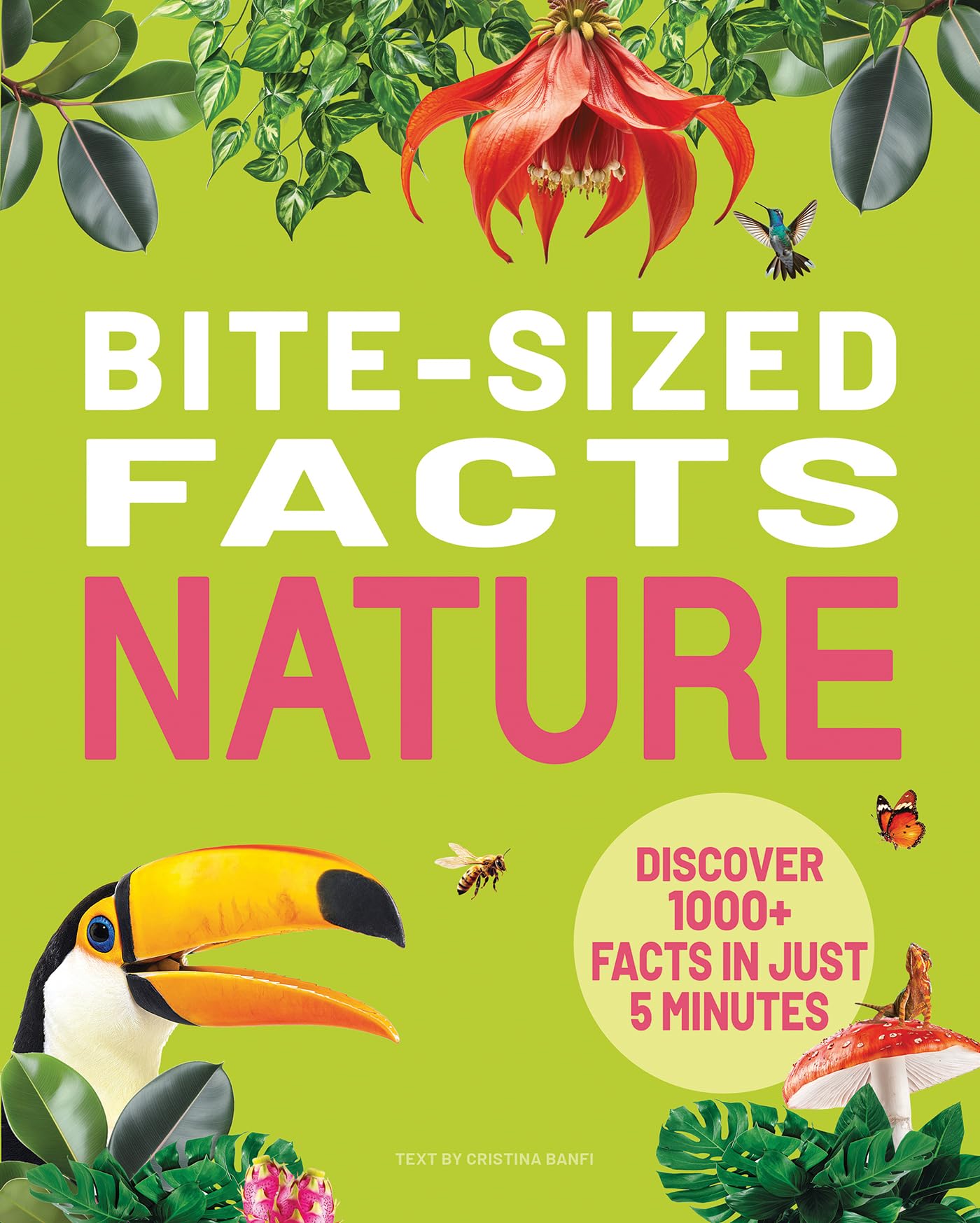
Cristina Banfi offers a fresh take on STEM education with Bite-Sized Facts: Nature, a nonfiction guide tailored for middle-grade readers who often find dense scientific texts intimidating. Instead of a linear narrative, the book uses a “micro-learning” format to deconstruct complex biological and geological concepts into digestible segments. The material covers a broad spectrum, ranging from the intricacies of plant biology and flower structures to the vast diversity of animal habitats and geological shifts. Banfi avoids overwhelming the reader with walls of text, opting for a layout that invites browsing. Students can hop between sections detailing specific animal adaptations or the dynamics of different ecosystems without needing to track a continuous plot. This structure transforms the reading experience from a daunting task into a series of quick, satisfying discoveries, making it an ideal resource for exploration rather than a standard cover-to-cover assignment.
This title serves as an excellent resource for educators supporting students who find traditional textbooks challenging or are in the process of acquiring English. The design strategy breaks information into distinct, manageable units, effectively reducing the cognitive load often associated with scientific literacy. For a student learning English, the extensive use of labeled diagrams and infographics offers crucial support; a learner struggling to parse a paragraph about the “melting pot of life” in a specific habitat can rely on the accompanying visual breakdown to grasp the core concept. The writing favors simple, declarative sentence structures that prioritize factual clarity over complex syntax. Essential scientific terminology is present but is consistently supported by context and imagery, allowing students to build academic vocabulary without frustration. By aligning with topics like biodiversity and land conservation, the book provides a factual baseline for inquiry projects, enabling teachers to address standard science curricula without the barrier of inaccessible prose. It helps reluctant readers engage with high-level concepts confidently, showing that complex science is accessible to everyone.